
News Center
Contact Us
Guangzhou Greater Machinery Equipment Co., Ltd.
+86 18529379000 Peter Xu (WhatsApp/WeChat )
E-mail:xkpacking@gmail.com
Filling machine display
- Location:
- Home
- »
- News Center
- »
- Filling machine display
Fish roe sauce and white mushroom sauce are used as seasonings and food ingredients, and their filling process requires equipment accuracy, hygiene standards, and operational stability. This article aims to explore the technical characteristics of filling machines designed for these two special sauces and their applications in the food industry.
Firstly, the core challenge of the fish roe sauce filling machine is to maintain the integrity of the fish roe particles. Fish roe sauce is composed of small particles, and traditional filling methods can easily cause particle breakage or uneven distribution. Professional equipment usually uses piston or gravity filling systems, combined with low-speed rotating feed mixing devices, to ensure that fish seeds are evenly suspended without being squeezed. The filling nozzle is designed with a large diameter and a buffering structure to reduce shear force. In addition, the equipment needs to have a quick cleaning function, as fish roe sauce is prone to residue and has a high oil content. Stainless steel material and CIP cleaning system have become standard. The temperature control module is also crucial, as fish roe sauce needs to be filled in a low-temperature environment to prevent spoilage. The equipment often integrates cooling jackets or cold air circulation systems.
The white mushroom sauce filling machine faces different challenges. The texture of white mushroom sauce is relatively viscous, containing fibrous mycelium and moisture, which can easily cause material blockage or measurement deviation during the filling process. For this reason, the equipment often adopts the principle of spiral conveying or screw pump, and controls the flow rate by adjusting the speed. The filling head is usually equipped with a heating device to prevent the sauce from blocking the pipeline due to low-temperature solidification. At the same time, in order to prevent the mycelium from being excessively stirred during filling and damaging the taste, the equipment needs to optimize the shape of the stirring blades to mix materials in a flexible manner. For white mushroom sauce containing particles, the filling valve should be designed with an anti pinch structure to ensure even distribution of particles.
Fully automatic sauce filling machine and display:
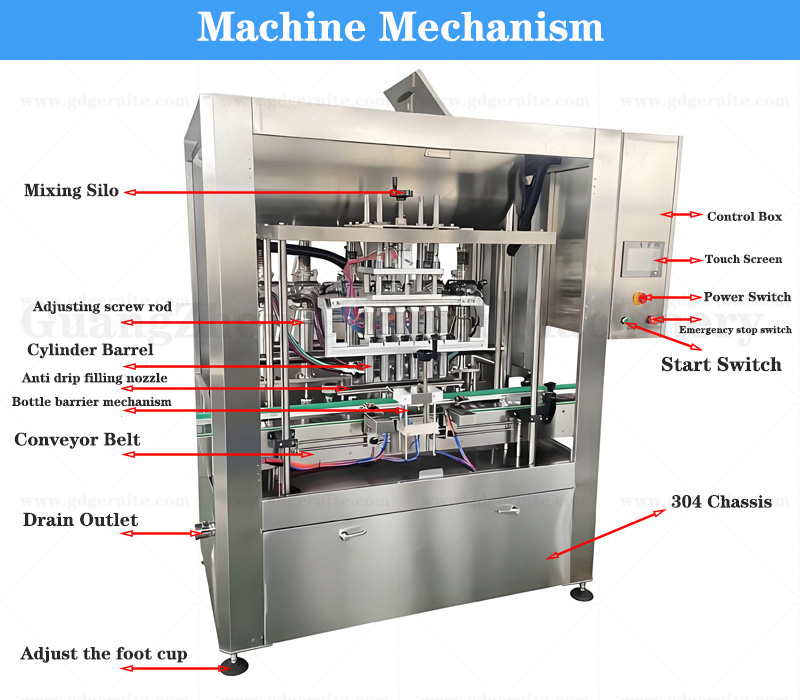
The two types of filling machines have commonalities in hygiene design. All parts in contact with materials must be made of 304 stainless steel, with a surface polished to Ra ≤ 0.8 microns to prevent bacterial growth. Seals must be resistant to grease and acidic environments, and comply with FDA standards. Automated control systems typically integrate weighing sensors and servo motors to compensate for filling errors in real-time, with an accuracy controlled within ± 1%. In addition, the device supports switching between multiple specifications of bottles and cans, reducing downtime by quickly changing molds.
In terms of market application, the fish roe sauce filling machine mainly serves the supply chain of aquatic processing enterprises and specialty restaurants. Its output is usually small, but it requires high customization. The white mushroom sauce filling machine is widely used in seasoning factories and vegetarian food producers, as the demand for white mushroom sauce as a vegetarian sauce market is steadily increasing. Both types of equipment must comply with HACCP system requirements, and some models already have data traceability capabilities to record filling parameters for each batch.
Although fish roe sauce and white mushroom sauce filling machines have their own focuses on different material characteristics, they both require high levels of precision control, hygiene and safety, and flexible production. With the increasing demand for food quality from consumers, future devices will develop towards intelligence and modularity, such as integrating visual inspection systems to remove damaged particles or achieving remote monitoring through the Internet of Things. Food production enterprises should choose specialized models with particle protection or viscous material handling capabilities based on their own product characteristics to ensure a balance between filling efficiency and product quality.