
News Center
Contact Us
Guangzhou Greater Machinery Equipment Co., Ltd.
+86 18529379000 Peter Xu (WhatsApp/WeChat )
E-mail:xkpacking@gmail.com
Display of capping machine
- Location:
- Home
- »
- News Center
- »
- Display of capping machine
Firstly, we need to understand the basic characteristics of marinade powder and marinade. Marinate powder is usually made by crushing and mixing various spices, salt, sugar, monosodium glutamate, starch and other raw materials. It has the characteristics of fine particles, easy moisture absorption, and poor fluidity. The marinade may be in powder, granular or paste form, and some products may contain oil or moisture, with high viscosity. These characteristics place high demands on packaging equipment. For example, powdered materials are prone to generating dust during the filling process. If not sealed tightly, it not only causes material waste but may also affect the workshop environment and the health of operators. Therefore, choosing a screw capping machine with stable performance and good sealing is crucial for ensuring packaging quality.
The main function of the capping machine is to automatically tighten the bottle body and cap of the filled material, achieving sealing. Its working principle usually includes steps such as lid sorting, lid delivery, bottle grabbing, and capping. On the production line of marinade powder and marinade, the capping machine is often linked with filling machines, sealing machines, labeling machines and other equipment to form a complete packaging assembly line. According to the degree of automation, capping machines can be divided into two types: semi-automatic and fully automatic. The semi-automatic capping machine requires manual placement of bottles and bottle caps, suitable for small batch and multi variety production modes; The fully automatic capping machine achieves unmanned operation through devices such as conveyor belts, capping machines, and robotic arms, making it suitable for large-scale and continuous production. For materials such as marinade powder that are prone to dust, fully automatic capping machines are usually equipped with dust removal devices and negative pressure adsorption systems to reduce dust spillage.
Prototype display of fully automatic capping machine:
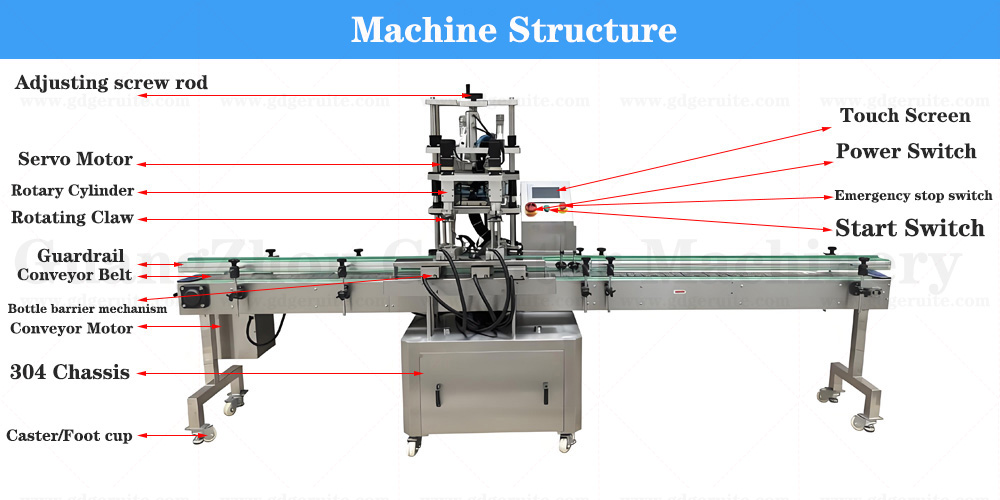
When selecting, enterprises should consider the following factors comprehensively. Production demand. Determine the operating speed of the capping machine based on the number of bottles that need to be packaged per hour or per shift. Bottle cap type. The commonly used bottle caps for marinade powder and marinade include plastic screw caps, metal caps, anti-theft caps, etc. Different cap types need to be matched with corresponding screw caps. Thirdly, the specifications of the bottle body. The diameter, height, and material of the bottle (such as glass or plastic bottles) will affect the clamping method and torque control of the capping machine. Fourth, torque accuracy. Loosening the screw cap can cause air leakage and moisture, while tightening it too tightly may damage the bottle cap or mouth. Therefore, it is recommended to choose a model with torque adjustment function. Fifth, cleaning and maintenance. The food industry has strict hygiene requirements, and the capping machine should be easy to disassemble and clean. The parts in contact with materials should be made of stainless steel material.
In daily use, operators need to regularly check the transmission components, belt tension, and wear of the capping head of the capping machine, and promptly clean up dust accumulation. For products such as marinades that may contain oil, it is also necessary to prevent oil stains from entering the mechanical structure to avoid affecting operational accuracy. In addition, it is recommended that companies establish equipment maintenance records, recording the time and content of each maintenance, in order to extend the service life of the capping machine.
Marinating powder and marinating capping machine are important equipment for improving packaging efficiency and product sealing. Enterprises should choose appropriate models based on their own production characteristics and pay attention to daily maintenance in order to achieve stable, efficient, and hygienic packaging operations and gain advantages in fierce market competition.