
News Center
Contact Us
Guangzhou Greater Machinery Equipment Co., Ltd.
+86 18529379000 Peter Xu (WhatsApp/WeChat )
E-mail:xkpacking@gmail.com
Packaging machine display
- Location:
- Home
- »
- News Center
- »
- Packaging machine display
In the modern food processing industry, marinade powder and marinade packaging machines play a crucial role.With the continuous growth of consumer demand for convenient seasonings, the technological level and work efficiency of such packaging equipment directly affect the market competitiveness of the products.This article will systematically explain the pickling powder and pickling packaging machine from the aspects of equipment functions, technical characteristics, application advantages, and selection points.
Marinate powder and marinate packaging machine are specialized mechanical equipment used for automated metering, filling, and sealing of powdered or granular seasonings. This type of equipment usually adopts spiral metering or measuring cup metering methods, which can adapt to materials with different flowability and packing density. Due to the fact that marinade powder often contains various components such as salt, sugar, spices, starch, and food additives, it has strong moisture absorption and adhesion properties. Therefore, packaging machines need to have good moisture-proof design and anti bonding structure. Common models include vertical packaging machines, multi column packaging machines, and bag feeding packaging machines, which can meet diverse needs from single package small specifications to industrial large packaging.
From a technical perspective, modern marinade powder packaging machines are generally equipped with PLC control systems and touch screen human-machine interfaces. The operating parameters can be digitally set, making it easy to quickly switch between different formula products. The application of high-precision sensors and servo drive systems enables measurement errors to be controlled within plus or minus one percent, reducing material waste. Some models also have automatic dust removal, anti-static, and nitrogen filling functions to extend the shelf life of the marinade powder and prevent oxidation and deterioration. In addition, the parts in contact with equipment and materials are mostly made of stainless steel, which meets food hygiene and safety standards and is easy to clean and maintain.
Sample display of powder packaging machine:
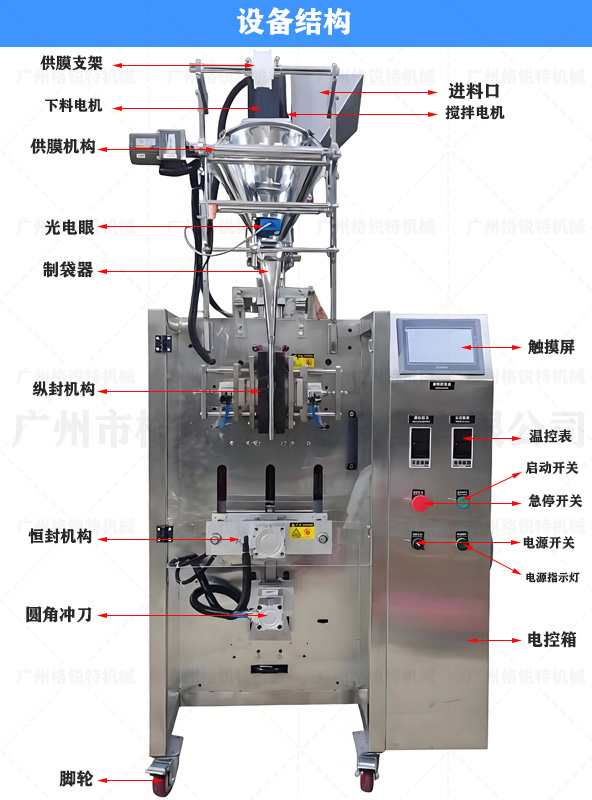
In practical applications, the use of marinade powder and marinade packaging machines has significantly improved production efficiency. Traditional manual packaging is not only slow, but also prone to dust flying, affecting the workshop environment and workers' health. The automated packaging machine can achieve a production speed of 30 to 80 bags per minute, with firm sealing and neat appearance, which is conducive to the display and sales of products on supermarket shelves. For chain catering enterprises or seasoning manufacturers, using such equipment can also reduce labor costs, ensure consistent weight of each package of products, and thus enhance brand reputation.
When choosing marinade powder and marinade packaging machine, attention should be paid to the following aspects. Firstly, clarify the material characteristics, including particle size, flowability, moisture content, and corrosiveness, in order to select appropriate measurement methods and contact materials. Secondly, determine packaging specifications and production capacity requirements to avoid excessive or insufficient equipment capacity. Thirdly, evaluate the technical support and after-sales service capabilities of equipment suppliers to ensure long-term stable operation. Fourth, pay attention to the cleaning convenience and safety protection devices of the equipment, such as emergency stop buttons, protective door locks, etc. Fifth, compare the energy consumption and noise levels of different models and choose products that conform to the concept of green production.
Marinating powder and marinating packaging machine are key equipment for the seasoning industry to achieve automation and standardized production. With the advancement of intelligent manufacturing, such devices will develop towards higher precision, stronger flexibility, and easier integration in the future, creating greater value for food enterprises.