
News Center
Contact Us
Guangzhou Greater Machinery Equipment Co., Ltd.
+86 18529379000 Peter Xu (WhatsApp/WeChat )
E-mail:xkpacking@gmail.com
Display of capping machine
- Location:
- Home
- »
- News Center
- »
- Display of capping machine
This type of capping machine is usually designed as a rotary or linear structure to adapt to different production speeds and site requirements. The core workflow includes several main steps, including lid sorting, lid delivery, lid grabbing, tightening, and torque control. Firstly, the haphazardly stacked bottle caps are directed and arranged by capping devices such as vibration discs or elevators, and then transported in an orderly manner to the capping station. Subsequently, the robotic arm or vacuum suction cup device accurately grasps a single bottle cap and smoothly places it on the mouth of the already filled bottle with grass fruit powder or clove powder.
The tightening action is the technical core of the entire process. The capping head is usually driven by a motor and equipped with precision torque sensors and clutch devices. After the bottle cap is placed in place, the capping head descends and covers the bottle cap, applying a controllable downward pressure while rotating. Torque control is a key parameter, and insufficient force may result in poor sealing, moisture or deterioration of the product; Excessive force may damage the bottle cap or neck threads, and even cause the bottle to break. An excellent capping machine can achieve stable and repeatable torque output, ensuring that the sealing quality of each bottle of product meets the preset standards.
For dry powder products such as grass fruit powder and clove powder that are prone to dust, special consideration should be given to cleaning and preventing cross contamination during equipment design. The contact part may be made of easy to clean stainless steel material and may be equipped with a vacuum cleaner to collect fine powder that may float near the capping station to maintain a clean workshop environment.
Prototype display of fully automatic capping machine:
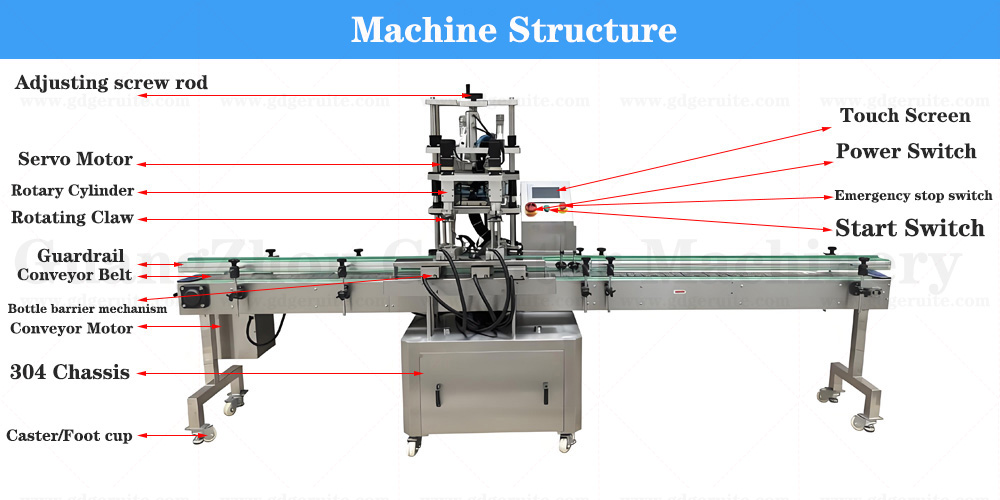
Capping machines often integrate advanced automatic control and detection systems. Through the cooperation of PLC (Programmable Logic Controller) and Human Machine Interface (HMI), operators can easily set and adjust parameters such as screw cap torque and speed, and monitor production status in real time. Visual inspection systems or sensors can be used to detect common defects such as missing covers, crooked covers, and slipping teeth, and automatically remove non-conforming products from the production line to ensure that the factory products are 100% qualified.
From the perspective of production efficiency, an automated capping machine can replace multiple manual workers, achieving high-speed and continuous operations. The speed can range from tens to hundreds of bottles per minute, greatly reducing labor intensity and labor costs, while avoiding hygiene problems and quality inconsistencies that may arise from manual operations.
When choosing bottled strawberry powder and clove powder capping machines, manufacturers need to comprehensively consider their own product characteristics (such as bottle material, size, bottle cap type), production capacity requirements, equipment compatibility, energy consumption, and after-sales service. Collaborating with reliable equipment suppliers and conducting thorough testing and validation is an important step in ensuring the long-term stable operation of equipment and meeting production requirements.
Sample display of fully automatic capping machine:


The bottled grass fruit powder and clove powder capping machine, through its automated, precise, and reliable operation, not only serves as a bridge connecting subsequent processes such as filling and labeling, but also provides a solid technical foundation to ensure product quality, improve production efficiency, and assist enterprises in achieving large-scale and standardized production.