
News Center
Contact Us
Guangzhou Greater Machinery Equipment Co., Ltd.
+86 18529379000 Peter Xu (WhatsApp/WeChat )
E-mail:xkpacking@gmail.com
Display of capping machine
- Location:
- Home
- »
- News Center
- »
- Display of capping machine
In the food processing industry, the vacuum capping machine, as a key equipment, plays an important role in extending product shelf life, maintaining food flavor and nutrition. Fish roe sauce and white mushroom sauce, as two high value-added sauce products, have particularly strict equipment requirements for their packaging processes. This article aims to analyze the working principle, core components, and operating points of vacuum capping machines suitable for these two products from a technical perspective.
Firstly, the basic working principle of the vacuum capping machine is to extract air from the bottle through a vacuum system, creating a certain negative pressure environment. Then, the capping mechanism is used to tightly seal the bottle cap, achieving a sealing effect. For fish roe sauce and white mushroom sauce, these sauces usually contain high moisture and oil content, and are sensitive to oxygen. Therefore, the vacuum degree needs to be controlled at a high level, and the residual oxygen content is usually required to be less than one percent. The equipment needs to be equipped with a high-precision vacuum pump, along with sealing rings and sensors, to ensure consistent vacuum levels during each cap rotation.
Secondly, the core components include the conveying system, vacuum chamber, capping head, and control unit. The conveying system needs to adapt to different specifications of bottle types. Small caliber glass bottles are commonly used for fish roe sauce, while wide mouthed bottles may be used for white mushroom sauce. Therefore, the equipment needs to have a quick mold change function. The design of the vacuum chamber needs to avoid the overflow of sauce during the vacuum pumping process, especially for the thick texture of white mushroom sauce, which is prone to producing bubbles. The pumping rate and path need to be optimized. The capping head should be made of stainless steel material to avoid reacting with acidic sauce, and equipped with a torque control system to prevent the capping head from being too tight and causing the bottle body to break or become too loose, resulting in seal failure.
Vacuum capping machine display:
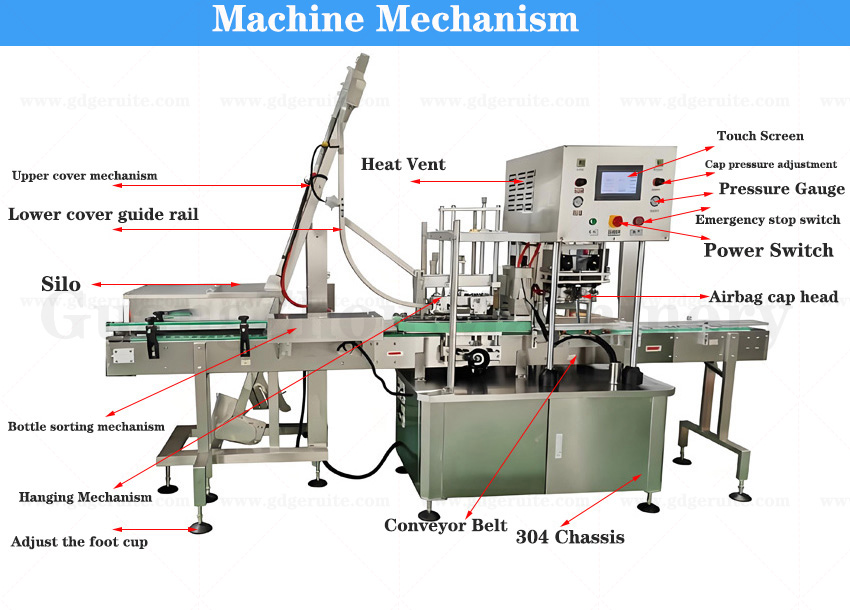
In terms of operational points, attention should be paid to the temperature of sauce filling. Fish roe sauce is usually filled at low temperatures to maintain freshness, while white mushroom sauce may require high-temperature sterilization and cooling, so the equipment needs to have temperature compensation function. In addition, cleaning and disinfection are key links in ensuring food safety. Equipment should be easy to disassemble, contact parts should meet food grade standards, and support online cleaning procedures. At the maintenance level, it is crucial to regularly check the oil level and seal wear of the vacuum pump, which can reduce downtime and extend equipment life.
In terms of application prospects, with the upgrading of consumption, the market demand for fish roe sauce and white mushroom sauce continues to grow. The vacuum capping machine can not only improve packaging efficiency, but also achieve production data traceability through vacuum degree monitoring and intelligent interconnection technology. For example, integrated sensors can record the vacuum value of each bottle in real-time, facilitating quality control. At the same time, in response to environmental trends, energy-saving vacuum pumps and recyclable packaging materials can be selected for equipment to reduce energy consumption and waste.
The vacuum capping machine for fish roe sauce and white mushroom sauce needs to balance efficiency, precision, and hygiene in technical details. By optimizing the vacuum system, screw cap module, and automation control, product quality can be guaranteed. In the future, with the deepening of intelligent and green manufacturing concepts, such devices will further develop towards modularity and adaptability, providing more reliable packaging solutions for the food industry. Enterprises should choose matching models based on their own production capacity and product characteristics, and pay attention to operational training and maintenance standards to achieve long-term stable production benefits.